
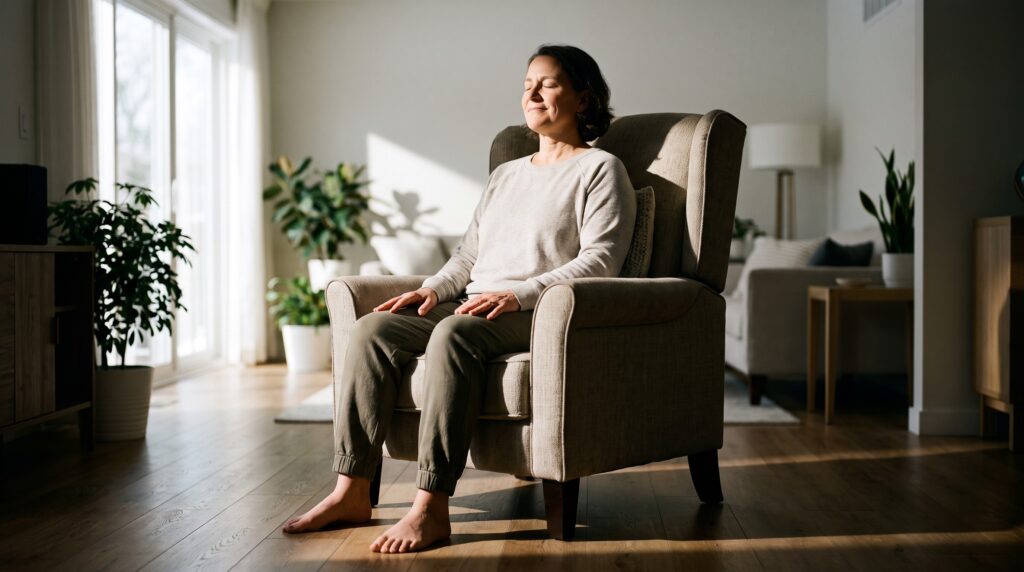
Meditation posture is one of the first things beginners worry about — cross-legged or not, straight spine or slouched, hands where exactly? It’s a reasonable question, and also, for Tranquil Mind, a much smaller one than most guides make it out to be. Here’s what actually matters, what doesn’t, and how to sit in a way that supports the practice instead of fighting it.
What Most Posture Guides Emphasize
Walk into most meditation instruction and you’ll find a fairly specific formula: sit cross-legged on a cushion, spine perfectly straight, chin slightly tucked, hands resting in a particular position, eyes at a particular angle. Some traditions treat this as close to essential — the idea being that a precisely aligned body supports a precisely settled mind, and that discomfort you push through builds discipline along the way.
There’s real history and reasoning behind this, and it works well for plenty of people, especially those with an existing yoga or long-sitting background. Nothing here is meant to dismiss it.
What Actually Matters in Tranquil Mind
Tranquil Mind’s whole approach is joy-first: smiling, ease, and kindness, because seriousness and struggle create tension — the exact opposite of what a calm mind needs. Posture follows the same logic. The goal isn’t a technically correct shape; it’s a position you can hold comfortably for the length of the session without fighting your own body the entire time.
If cross-legged on the floor is comfortable for you, wonderful — sit that way. If it’s not, a chair works exactly as well. What matters is whether the position lets you be both alert and relaxed at the same time. A posture that’s technically traditional but leaves you gritting your teeth through knee pain isn’t doing the practice any favors — it’s just adding a second thing to struggle with, on top of the mind wandering that was already going to happen anyway.
A Few Practical Guidelines, Not Rules
Sitting: chair or floor, either is fine. A chair with your feet flat on the ground works as well as a cushion on the floor. Pick whichever you can hold without needing to think about it.
Spine: upright-ish, not rigid. A gentle uprightness helps you stay alert rather than drift toward sleep, but “upright” doesn’t mean “ramrod straight.” Relaxed and tall is the target, not braced.
Hands: wherever they’re comfortable. Resting in your lap, on your knees — there’s no required mudra here. Comfortable and still is enough.
Eyes: open or closed, your call. Closed eyes make it easier for most people to settle into the feeling of loving-kindness without visual distraction. If closing your eyes feels uncomfortable or unsafe for you, a soft, downward gaze works fine too.
Shifting mid-session: allowed. Many traditions ask you not to move once you’ve settled, treating stillness itself as part of the discipline. Tranquil Mind takes a more relaxed view: if you need to adjust because something’s gone numb or genuinely uncomfortable, adjust. Quietly resettling and returning to the practice costs you far less than white-knuckling through real discomfort while your attention is entirely on your knee.
If you’d like step-by-step setup for a particular position — a chair, a cushion, kneeling, or lying down — our sister site for beginners, Learn How To Meditate, has a practical guide to meditation positions.
What About Pain?
Mild restlessness or the ordinary fidgetiness of sitting still is normal and worth gently working with, the same way you’d work with any other kind of distraction — the 6Rs apply here too. But actual pain is different information entirely, and it’s not something to push through as a badge of discipline. If a position hurts, change it. There’s nothing in Tranquil Mind’s method that asks you to prove anything to your knees.
Common Questions
Do I need a meditation cushion?
No. A cushion can make floor-sitting more comfortable if that’s your preference, but a regular chair works just as well for the practice itself.
Can I meditate lying down?
You can, though it comes with one practical trade-off: lying down makes it easier to drift into actual sleep rather than meditation. If you’re using it for a nighttime practice, that’s not necessarily a problem — otherwise, sitting tends to keep you more alert.
What if my legs fall asleep or my back starts to hurt?
Adjust. Quietly shift position and return to the feeling of loving-kindness. This isn’t a rule you’re breaking.
Does walking meditation count if sitting still is hard for me?
Yes — walking meditation uses the same object and the same 6Rs, just in motion instead of seated. It’s a completely legitimate way to practice, not a lesser substitute.
Try It for Yourself
Posture is a small piece of a much bigger practice. The complete Tranquil Mind method walks through the whole thing, and if you’d like a real teacher to help you find what’s comfortable for you specifically, Tranquil Mind offers free one-on-one guidance — always free, because we’re a nonprofit.
May you be happy. May you be peaceful. May you be free from suffering.
