
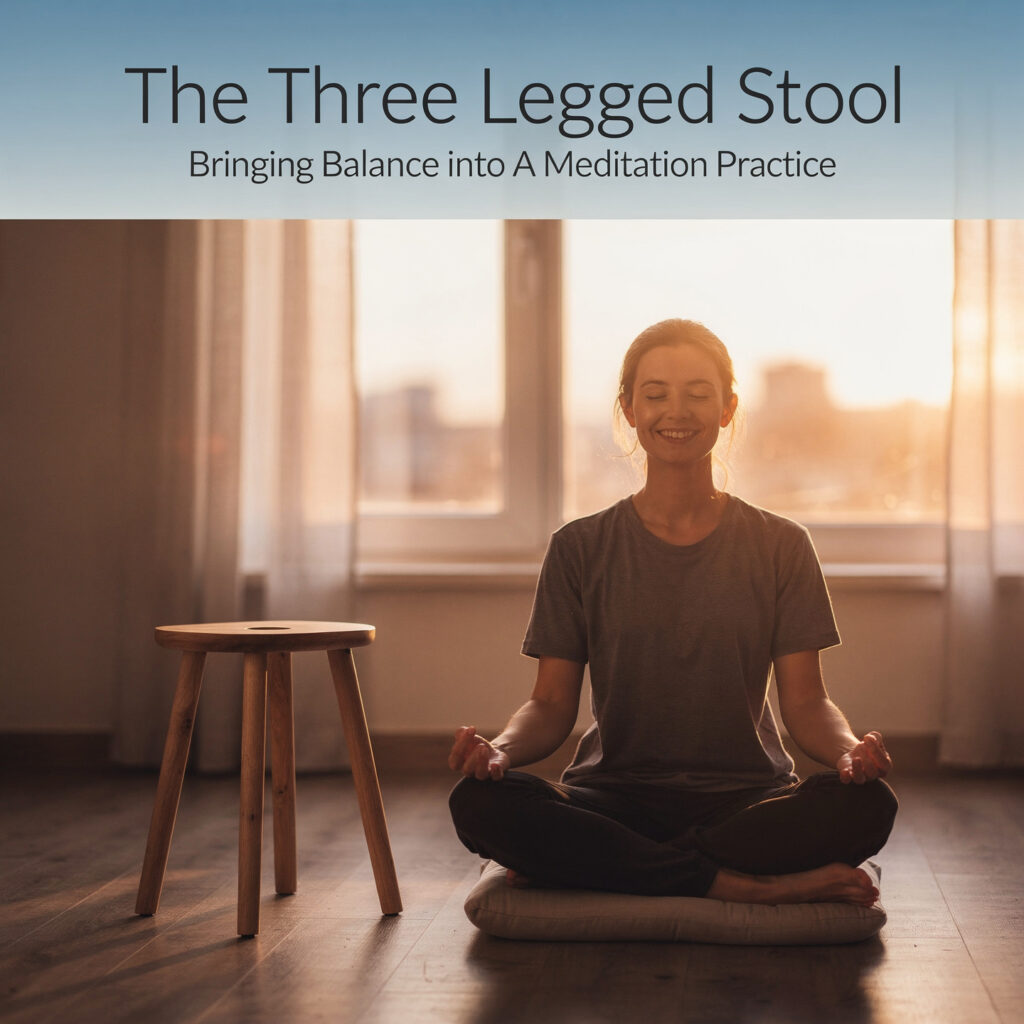
The Three Legged Stool
Bringing Balance into Meditation Practice
by Mark Berger
Introduction
Thank you for the opportunity to talk to you this evening about awareness meditation practice. I am excited about a traditional style of practice that has helped me move from a plateau of daily practice to deep experiences. And in the process brought me back to the cushion again and again. It is the greatest show in town.
I have been engaged in meditation on a daily basis for over four decades and am familiar with many different styles. Today we have a spectrum of awareness meditation practices; on one side is MBSR (Mindfulness Based Stress Reduction) and on the other side is classic mental training instructions that come from the Pali Canon. Many of these point to a way of bringing balance into the mind. And what I want to talk about today is deepening the practice through what I call the three legged stool.
This is focus on bringing balance into the meditation practice from three areas of mental training: the first is having a mindful attention, the second is a collectedness or concentration of mind, and the third is tranquility practice. Each of these legs have to be strong to have a balanced meditation practice. In the classic styles of meditation we see these mental skills are aimed at a goal of awakening.
Meditation practice is mental training that can be seen with the metaphor of physical training, where there are a variety of physical exercises that can produce different results. Such as a triathlon that has three different kinds of skills for swimming, biking, and running. Each of these skills work to support each other and one has to know how to swim and bike and run… to finish. The same is true of mental exercises which have a focus on skills of awareness/mindfulness, a collectedness of mind, and emphasis on tranquility. This brings about a balance in the mind, with the traditional goal of the Buddha’s teaching being freedom from suffering, liberation, and awakening.
Awareness – Attention
The first leg of the stool is the practice of awareness. We commonly relate to the term mindfulness, and yet this has come to mean many things from the different styles of practice. Sometimes mindfulness is applied to the universe of our experience. However, in the suttas the application is a little more focused. One scholarly definition that is useful is “Remembering to observe how mind moves from one object to another” (Repeat… 2X). This is focusing on what is coming into our consciousness, as well as being ardent in applying the mind to remember to be alert to our experience.
What I want to share with you today are aspects of mindfulness as an awakening factor. This is described in MN10, “the Satipatthana Sutta,” commonly known as the “Foundations of Mindfulness.” Books and PhDs have been written on this one sutta, and various aspects of it have developed styles of vipassana practice. The four foundations are the body, feeling, mind, and mind objects.
In the first foundation we are introduced to the mindfulness of the breathing. The sutta describes how one sits down, body erect, establishes mindfulness in front of him and, ever mindful, he breathes in, mindful he breathes out. Breathing in long he understands “I breathe in long,” breathing out long he understands “I breathe out long.” Breathing in short he understands “I breathe in short,” and breathing out he understands “I breathe out short.” He trains thus: “I shall breathe in experiencing the whole body.” And he trains thus: “I shall breathe out experiencing the whole body.” He trains thus: “I shall breathe in tranquilizing the bodily formation.” He trains thus: “I shall breathe out tranquilizing the bodily formation.” This actually describes the three legs of the stool working together: mindfulness, understanding the breath; concentration, experiencing the whole body; and tranquility, calming the bodily formation. I will develop these ideas as we go on.
These instructions show the mindfulness following the flow of experience with the breath. The breath is dynamic, and the mindfulness awakening factor is gentle and can be playful. In the Thai forest tradition the mind is placed on a pleasant experience in the body where the breath feels good. This creates a positive experience and helps the mind stay with the object of concentration, and enables the application of relaxing the bodily formations as the breath goes in and out. The mindfulness and tranquility work together to provide direct knowledge and understanding. I will talk more about the tranquility practice later, as one of the legs of the stool.
The next foundation for mindfulness is feeling, and in the Buddha’s context of mindfulness this is the experience of positive, negative, or neutral. This comes from the Buddha’s description of how we experience the world and what conditions our experience. He described a series of events that were conditioned upon one another and called this Dependent Origination. It is a simple set of experiences that start from formations arising out of ignorance and proceeding to the end of life.
The portion that is important for us are the experiences coming into the sense doors and creating contact with sights, sounds, touch, thoughts, smells, and tastes. This contact then in turn creates feeling. Can we apply our mindfulness to be aware of the nature of the feeling that has occurred in each sense door when it happens? The next stage of Dependent Origination is the identification with the experience… the “I like it, I don’t like it” mind. This is another place for mindfulness to see the opportunity to be aware and release the craving mind, which is leading away from the cessation of suffering.
The next application of mindfulness is the contemplation of the mind. This is more of looking into the mind to see what the current climate conditions are. What is the mind affected by? Is the mind attracted to wholesome objects? Are wholesome thoughts present? Have unwholesome objects arisen? What can be done to prevent unwholesome states of mind from arising? This awareness is seeing the present state of mind – such as the mind distracted, affected by lust, hate, delusion, or ignorance. And in this context, ignorance means not knowing the Four Noble Truths. In this contemplation the mind is also examined in terms of the mind that is exalted, surpassed, concentrated, liberated, or unliberated. This contemplation has many levels, with the beginnings at gross activity for the new meditator and progressing to extremely subtle experiences of the formless realms of the deeper stages of understanding. The mindfulness is present in all of them and assists in the knowing when the mind is moving from one object to another. This alert awareness helps the process continue with deepening of the practice.
The next foundation of mindfulness is the contemplation of the mind objects. These are five basic groups of practice experiences and elements in the application of mindfulness as an awakening process.
The first group are the five hindrances, which are used to provide signals as to the nature of the mind. There is restlessness, doubt, sloth and torpor, sensual desire, and ill will. The awareness is the knowing of when these have arisen and come to be, and when they are abandoned with a future non-arising. We each have our own repertoire of how our personal hindrances manifest, and our mindfulness will show us the beginnings of these coming into our experience. It is as if the mind begins to be agitated and forms a kind of hindrance. These are not to be seen as problems in the mind but as teachers of what is going on now. The nature of the hindrance will also show the level or lack of energy that is happening and what is needed to come back into balance.
The next set are the five aggregates, which are form, feeling, perception, consciousness, and formations. The application of mindfulness on these at subtle experiences sees the sensations of the body, which are the form experiences. The next is the feelings, which are positive, negative, or neutral experience from the senses. The mental naming of what is happening is perception, and the knowing of what is happening is consciousness. Mindfulness is the knowing of what is present and observing the mental movement from one to another.
The next set is the six sense bases, which is understanding each of the experiences of our senses – knowing when they arise and knowing when they pass away. There is knowing without clinging or identifying with these senses.
The next set of elements are the seven enlightenment factors, of which mindfulness is the first and serves as a fulcrum between those factors, such as investigation, right effort, and joy, that create energy, and those factors, such as tranquility, concentration, and equanimity, that create calm. The mindfulness sees the balance or imbalance and shows what is needed in the practice.
The last group in this section are the Four Noble Truths, one of the most basic of the Buddha’s teachings, which begins with: there is suffering, there is the cause of suffering (craving), there is a cessation of suffering (awakening), and there is a way leading to the cessation of suffering (the Eightfold Noble Path). The Four Noble Truths are found throughout the teachings. The mindfulness sees the present with each of these truths as a frame of reference for insight and wisdom.
This is a summary of how mindfulness as an awakening factor is applied. Its importance is in knowing what is present and showing what is needed for sustaining wholesome mental states. It is essential in balancing the mind, and is one of the legs of our stool.
Collectedness of Mind
This is the second leg of the stool, commonly known as samadhi or collectedness of mind. There are many ideas of what this collected mind is, how to do it, many styles of practice, and many different mental results from what is used as an object of meditation. This is the placing of the mind on the object and keeping it there. A sutta in MN 149 says awareness and collectedness are yoked together. It is necessary to use them both on the path to awakening. This is one of the calming factors of enlightenment and is considered an essential part of the practice. It is a mental strength that comes from disciplining the mind to stay on its object and is used as a frame of reference as to how the mind’s energy is being used. What this means is that you can judge the condition and energy of the mind with the quality of the collectedness. This comes from the experience and knowledge of how your mind’s ability to stay focused is working.
Collectedness can be narrow in focus and it can be broad, depending on the object and the present state of the mind. A common object of meditation is the breath. There are three reasons for this: one, it is a neutral object; two, it is always present; and three, as the breath gets more subtle it causes us to pay more attention. The breath is used in many styles of practice, and one style is attention to the whole body. Another style is breathing in and out of certain areas, or following the energy flows in the body. There are many drills of counting the breaths to develop the strength to stay on the object. And as the concentration grows, the mind stays with the object for a longer and longer period of practice. Eventually the monkey mind stops.
Concentration can be a playful practice that starts with some simple exercises that bring the mind into focus and gently train it to stay with the object of meditation. Sometimes this preparatory work is like an athlete stretching before a run. It helps turn the mind toward the practice with gentle steps and can be like following the energy flows within, or placing your attention at one place then another, or sweeping the body from side to side or top to bottom. After this is done, the mind can be placed on the object of meditation, and the practice is to see how long it stays there before it is drawn away. With skillful practice this can become longer and longer.
Thanissaro Bhikkhu, or Than Geoff, recommends finding a place in your body where the breath feels the best and using that place as the object of meditation. This allows the practice to have a pleasant anchor point when watching the breath in the body… which is a very dynamic process.
Sometimes collected practice is taught as one-pointed to the extent that it blocks out the sense doors of consciousness and stops the hindrances. This has the effect of not giving the practitioner the knowledge or opportunity to process the material found or relate to the nature of their mind. The focus can become so strong, and the practice can go very deep, but the practitioner is generally unaware. Meditation time can go by very fast and seem pleasant, but without the mindfulness the practice is relatively unproductive or unskillful. This is subtle because concentration makes the mind focus, but when it goes deep the sense doors are ignored and an hour of practice can go by in a heartbeat. This is not skillful training of the mind, nor is it going toward awakening. It is a pleasant plateau where the energy is very still and quiet. The mindfulness is weak and may or may not be present. There can be a lot of tension in a one-pointed mind, and when this happens there is the need to investigate how the mind is working. What are the formations that are coming into consciousness? How is our reality manifesting? This indicates that this leg has become too strong and there is a need to be aware and relax. This brings the mind back into balance, to lighten and move toward awakening.
Some common exercises for developing a collected mind are counting the breaths with either a two-part count or a three-part count up to ten and then repeating. Another exercise is moving the attention through the body from the toes up to the head, sending loving kindness to each part – and if the mind wanders, start over; at the end, send loving kindness throughout the body. Another exercise is sweeping the body with a sequence such as top to bottom, bottom to top, front to back and back to front, inside to outside, outside to inside, head to heart, heart to head, and from left hand across chest to right hand and then right to left. It is also possible to follow the energy flows in the body on the inhalation and the exhalation. You can make up your own exercise. All of these are designed to help the mind stay with the object, and this can be done in a playful way and hopefully with a little fun. The idea is just to stay with it and strengthen this quality of mind. After this initial drill, then the mind can be placed on the object of concentration, such as the breath.
Tranquility
This leg of the stool is mentioned in five suttas, and three times in the Satipatthana Sutta, the Foundations of Mindfulness, which is the basis for awareness practice and vipassana. It is also one of the calming factors in the seven factors of enlightenment.
I began using a relaxation response about 16 years ago, and it has made a significant qualitative improvement in my practice. It can be used by someone who started their practice yesterday, and by those who have been practicing for decades. The Buddha told us what to do in terms of practice by tranquilizing the mind and body, but not how to do it. One of the ways to create this relaxation response is to use what is called the 6Rs. This calming practice is a core part of the Tranquil Mind method, and is a simple way to train the mind to relax. The 6Rs stand for recognize, release, relax, resmile, return, and repeat. It is in alignment with the Eightfold Path and the elements of right effort.
The First R: Recognize
This means that the meditator notices that the mind has moved or started thinking. The noticing of the activity is the beginning. This is the application of awareness and being alert. At first one may only see this happening after a succession of thoughts. But as sensitivity increases and the quality of attention is applied, the meditator begins to notice at a subtle level earlier and earlier as the event (or thought) comes into consciousness. During meditation and daily life this recognizing also takes place with all the events coming in through the sense experiences, such as hearing, tasting, smelling, touching, seeing, and thinking. It connects with the early teaching, pointing the meditator at seeing the cycle of consciousness (Dependent Origination) that has contact with the senses, then the feeling, then tightness in the mind in the form of craving or identifying with the event. The awareness cuts off this cycle at an earlier point and allows for the shift to the next step, the next R. It is also important to know that these events that take place in consciousness change from being large or gross to very subtle. The mind will see the big objects at first, and as it gets concentrated and aware, the events get softer and the mind moves less and less. It can be, as the meditator gets deeper into the levels of understanding, that the mental movement is like a slow mental twitch at a very deep place. There is also the space at this time to cultivate the reflection that this is not me, not I, not mine, and not myself.
The Second R: Release
This is to allow the thought or sensory event to be there and not to push it away. Whatever happens is OK. It is opening to see it clearly and knowing that it is just a thought, or a memory, or a sound… etc. This step of alert mindfulness is a knowing of what the topic or tension is about, and giving the space to be left alone without keeping our attention on it. This means not examining the content (which may be appropriate at another time) or asking why it arose. It is simply allowing whatever is in the field of awareness that has taken us away from our meditation object to be seen and released. The tension may be seen, experienced, or known that is surrounding that issue. At very deep states, the release may not have an object but only the knowing that tightness is present. In this way the release may be applied globally in the mind.
The Third R: Relax
This is the key of the calming practice – to relax any tension in the mind. What is the sensation of relaxation? Each person carries tension in different places and different ways, and each will relate to relaxation in their own way. Most people will notice a tension around the head, and a way to release it is to soften and gently open and relax. You can feel a physical sensation of the softening in the body with the relaxation experience. The mind and body work together in this response. This is also applied to the events in the sense doors, as a sound may create tension because it is unwanted, or pain in the body can create tension in the mind or vice versa. With practice one can see where these places are, especially in the mind or body, and relax those places. The mind will then come into a place of balance and openness and it will be quiet (at first this may be momentary). Then the meditator’s attention can return to the object of meditation with a calm disposition and continue to practice. In the beginning of this relaxation process, the objects in our mind are very gross, and when the relaxation occurs it can be profound and feel like a huge burden has been released. As practice continues, the movements of the mind’s attention are less, but the tension is there. The relaxation can be experienced as the mind opens, becomes still, and is alert. It is agile and easily recognizes the slightest movements of the mind’s attention.
It is important to know that this relaxation process changes through the practice. It is an important part of the stool. At first it is applied to gross mental material, and later it is so subtle as to be almost imperceptible. In the formless states of the levels of understanding (the arupa jhanas), the mind has tension, and as it is released the mind goes deeper and stays in balance on its object of concentration. It is the gentle application of attention to these subtle changes that indicates tension has arisen somewhere, and it is the application of the 6Rs that releases the tension and helps the practice to continue. This relax step is frequently not included or emphasized in meditation instructions, and because it is skipped, the meditator misses the opportunity to relax and let go of some tension in the mind (which can lead to an overly focused mind, or absorption, that can suppress parts of one’s practice). The result is that it is very difficult to see this at the subtle levels, and the mind can become so collected in the object that it loses awareness in the depth of concentration. This is an example of absorption, or one-pointed concentration, and it is not a useful or skillful practice on the path to complete awakening, as the way the Buddha taught.
The Fourth R: Resmile
This is a practice that helps uplift the mind. It is smiling during the meditation – smiling with the heart, lips, eyes, and mind. It is returning to this positive state of being after relaxing. It helps keep a continuity of the process, and as the mind becomes quiet with equanimity, compassion, and joy, the good uplifting feeling is embraced with a smile. It is a way to make the meditator look at everything from an open and happy perspective. The condition of not having the smile is sometimes noticed first, and then it is noticed that the mind is no longer on its object, and the calming process of the 6Rs begins again. So this step of resmiling and keeping a happy face is an important aspect of having a balanced, happy perspective in all aspects of our lives. It is also a way to practice right effort: cultivating wholesome states of mind, refraining from unwholesome states of mind, and releasing unwholesome states – especially when doing our daily activities!
The Fifth R: Return
This is returning to where you have placed the mind – for example, the object of meditation. Depending on your chosen object, this may be the breath, a feeling like loving-kindness, equanimity, etc. This is bringing a calm mind back after it has relaxed from the tension and tightness. Then the mind’s attention comes back to the object of meditation with joy, alertness, calmness, and balance. The mind’s attention continues with the practice of focusing on its determined object of concentration/meditation with full and clear mindfulness. This allows the mind to be reapplied to the object and continue with its chosen practice. The mind then naturally comes back refreshed and ready to begin its task again. This makes the discipline easier and more successful in its goals of liberation at any level in the meditation.
The Sixth R: Repeat
Repeat the process every time the mind is recognized as leaving its object. At the subtle levels it may be repeated as anything is registered at the sense doors, because the contact there has created some tension at some level. The whole process may be repeated many times in a single meditation session. And if the relaxation step occurs each time, it is a good meditation – an active meditation for sure, but a good meditation nonetheless, because the meditator is letting go and relaxing, and this improves one’s mindfulness.
The important thing to know is that the 6R process changes. At first it is somewhat mechanical as the meditator learns to do it. Each step is seen and sometimes verbalized. As the process becomes more familiar, easier, and quicker, there is no verbalizing, and it is like the mind doing a gentle flowing motion to relax and return to the object. As the practice deepens in the stages of understanding it becomes even softer and quicker, so that when the mind is seen making the slightest movement, the relaxation response occurs and it settles down and goes deeper… constantly relaxing the mind. The tranquilizing takes on a different role as a tool to gently apply to all the tension in the mind, no matter how little or large it may be. The calming practice gets used in our daily life, as when a disturbing event takes place and we use this drill to relax and find a skillful way to deal with the situation at hand. It is most important to know that just seeing the problem and returning to the present moment does not qualitatively calm our minds. The relaxation step has to be inserted in the process to effectively change the mind in a wholesome fashion. It is a very powerful and subtle tool that can be used from the beginning of the meditation practice all the way through to the initial awakening and beyond. Perhaps the best result in calming the mind is the momentary relief felt after relaxing the mind. This is the cessation of suffering for that moment.
For the traditional meditation practitioner, this tranquility practice is in the Eightfold Path in the area of right effort. It is a practice composed of four parts: the first is seeing the mind caught by an unwholesome thought or feeling; two, letting go of that unwholesome thought or feeling, relaxing and smiling; third, redirecting this lighter mind back to a wholesome object; and fourth, keeping the practice going.
The idea is to make this smooth and easy and simple. When the mind is busy it may be done over and over. And again, if you have a meditation where you have to do this 50 times and you come back to a moment of stillness, it is a good meditation. Each of those moments is a moment of balance. I use this tranquilizing process in every sitting, and throughout the day when stress arises. The relief is immediate.
How the Three Legs Work Together
This is how the three legged stool works together: mindfulness, collectedness, and tranquility. The three legs are used in a balanced fashion to promote deepening the meditation practice rather quickly. Here are some examples that can occur in practice.
Examples
Sometimes restlessness arises in the mind. It has many forms, both physical and mental, with combinations of both. It can be very gross or very subtle. In the practice, mindfulness shows you when it is arising, and this helps in effectively knowing its beginning. The application of the tranquility practice, at this time, to release the tightness and tension, weakens this hindrance and shows the presence of weak concentration. When the return to the object of meditation is done, there is an openness and a wholesome state of mind present. This may have to be done several times, but each time returning to a deeper place, more relaxed, some stillness, and the practice continues in a more skillful manner. A peace is found that is free of defilement. The balance returns. The concentration leg is strengthened.
Sometimes we begin our sitting with a busy mind – lots of thoughts, concerns, the daily spread of mental activity. It is hard to concentrate, and there is the need to soften the mind and bring up the tranquility practice. This can manifest as relaxing on the in-breath and relaxing on the out-breath. This practice may continue for 5–10 minutes or more until the mind finally settles down. This is using the 6Rs on the in and out of each breath. You can see, as the mental activity decreases, the concentration improves as a result of your tranquility practice. It may not be immediate, but your skill in calming the mind will grow with repeated use. This is strengthening this leg of the stool.
In practice, the mind can become dull as the hindrance of sloth and torpor is present. This can happen when the concentration is too focused and one-pointed and the mind goes too deep. My experience is that this can be pleasant, and the sitting time can go by very quickly, but the energy can be low. The awareness and alertness of the mind sees this arise and notices the need to raise the mindfulness energy through investigation of the moment. This paying closer attention to what is happening as the consciousness arises and comes into being creates higher energy, and the sloth and torpor passes. The mind can gently return to balance and its object at a deeper place, with more awareness, and the practice continues. The mindfulness leg is strengthened.
In the deeper state of practice, the mind is settled, resting on the object like equanimity, and the mind sees it start to move ever so slightly. With the awareness of this and the initiating of the relaxation response – calming the mind – to relax any tightness and tension, the mind settles down, the practice continues, at yet a quieter place… the balance for the stool returns.
So you can see how the hindrances can show you your state of mind. They are useful and necessary all the way along on the path. They show you how and when your three legged stool is out of balance. The nature of the practice is to strengthen these three skills of awareness, collectedness, and tranquility, and keep them in balance. I know over a dozen people who have had an awakening experience, and it has been a profound change in their lives and inspired many people to increase their faith in what the Buddha was teaching. The traditional practices work, and it does not take a lifetime to have this experience. I have seen novice yogis experience the first stage of path knowledge, which is the first experience of nibbana (in Sanscrit: Nirvana), in less than a week. To me this is phenomenal, exciting, and very inspiring. It shows that what the Buddha was teaching is real, attainable, and the process is described clearly in the suttas.
Conclusion: Six Final Suggestions for All Types of Meditation
- Sit longer, and with comfort. This helps deepen concentration and uses the momentum of practice to quiet the mind. For myself, sometimes it takes an hour for the practice to settle down and really begin.
- Practice throughout the day. Use mindfulness as much as possible, practice the tranquility when stressed or irritated, use the 6Rs. Concentrate on what is happening in the moment.
- Smile as much as possible. It promotes right effort and wholesome states of mind and gives an upturned, positive frame of reference. Have fun.
- Make your meditation experience a game and allow yourself to make mistakes. It is a practice that grows with experience and does not improve linearly… as we all know.
- Try not to have a mental model of any state that will take you out of the present moment and cause suffering with the comparing mind, which has craving and increases stress in the present moment. This can happen at the most subtle states – the aware mind saying “that’s not it, I know good meditation”… etc.… “been there, done that!”
- Thanissaro Bhikkhu says to allow yourself to be gently attached to the wholesome practice of meditation, wholesome states, walking on the path, wanting to be awakened, and some of the inspiring experiences that come from deeper meditation. This can be a minor form of wholesome craving. Eventually all identification and craving will have to be released for liberation at some advanced point. This is called disenchantment, and it is seeing the emptiness of self in all experience. And yet you are creating your own dharma raft to cross the stream for your awakening. It is not necessary nor skillful to throw away useful mental skills and fear a minor attachment to mental states that support your experience, because you are cautioned not to be attached to anything. The practice is one of nurturing your process to the point of naturally awakening, with wholesome states of mind, as you cross the stream and become free of suffering.
May you all attain freedom, liberation, and the highest happiness with your practice.
